

The ERP software market was valued at USD 92.6B in 2025 and is expected to reach USD 281.58B by 2034, growing at 13% CAGR. North America led with 34.20% share.
Source: Fortunebusinessinsights
Business technology has developed over time in response to the increased complexity of business and the need for organizations to remain competitive in the marketplace. For instance, in the past, organizations used various standalone systems for managing their accounting, payroll, inventory, and sales needs. These systems, though implemented for meeting specific business needs, were generally not developed with a focus on integration and a cohesive system approach. With the increased use of AI in ERP systems, organizations are moving towards a more integrated system. As a result, data fragmentation, manual reconciliation, and limited cross-department visibility became common challenges.
The business operations of an enterprise call for a more unified and strategic approach. This is because decision-makers need consolidated information, process automation, and infrastructure to support growth and regulatory demands capabilities delivered through enterprise resource planning software. It is the change in business requirements that differentiates the current ERP systems from other business software packages.
What is ERP?
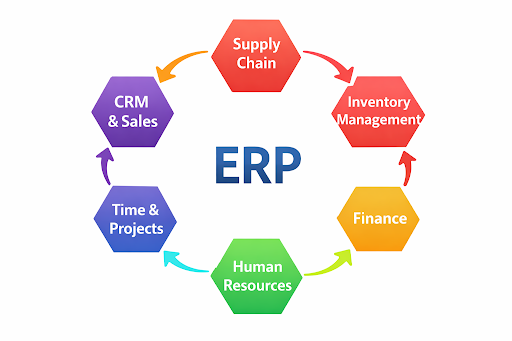
Enterprise Resource Planning (ERP) is defined as a software solution that integrates various business functions. This system helps to integrate various areas of a business, such as finance, human resources, procurement, inventory management, and sales.
The main goal of ERP is to improve the efficiency of a business by increasing the accuracy of the data used. When discussing ERP system overview, this integration becomes a key factor since the data entered into one part of the system automatically appears in related areas.
By providing real-time visibility into business performance, ERP supports informed decision-making and long-term scalability. This is especially evident with erp for supply chain management, where integrated data improves coordination and efficiency across operations. It acts as the digital foundation that aligns people, processes, and technology to drive operational excellence.
What Are The Types Of ERP?
There are various types of ERP systems, depending on the deployment model and organizational needs. The knowledge of types of ERP systems will allow organizations to select the right type of ERP system that best fits their organizational structure.
On-Premise ERP
On-premise ERP refers to a type of ERP system where the organization hosts its servers internally. The organization is in charge of its infrastructure, security, and upgrade costs. This allows organizations to have control over their data and to customize their ERP systems.
Cloud-Based ERP
Cloud-based ERP uses external servers and internet access, forming a key part of cloud based business software. It operates on a subscription model with automatic updates and built-in security.
Hybrid ERP
Hybrid ERP uses a combination of on-premise and cloud-based ERP systems. The organization uses its own servers to store sensitive data and uses the cloud-based features to provide flexibility and mobility to the users.
Industry-Specific ERP
These ERP systems are designed to cater to the specific needs of particular industries like manufacturing, healthcare, retail, construction, finance, etc.
Small and Mid-Market ERP
These ERP systems are designed to cater to the specific needs of small and mid-market enterprises with an emphasis on core functionality and flexibility in terms of scalability. With next generation erp, they have become more flexible while being cost-effective and simple to implement.
What is The Difference Between Modern ERP And Traditional Software?
| Aspect | Modern ERP | Traditional Software |
| System Architecture | Flexible and modular architecture, including support for APIs and integration tools. | Generally inflexible and self-contained, with limited integration capabilities. |
| Deployment Model | Cloud-based or hybrid deployment model, which allows access and updates from anywhere. | Mainly based on the on-premise deployment model, which requires local servers and updates. |
| Data Management | Based on a single database, which offers real-time data synchronization among all the departments. | The data is stored separately in different systems, which creates problems in data reconciliation. |
| Scalability | Designed to scale easily across locations, business units, and geographies. | Expansion often requires significant customization or system replacement. |
| Accessibility | Accessible securely across various devices and locations. | Generally, it is used for internal networks or installed systems. |
| Automation Capabilities | Supports the automation of workflows, use of AI for insights, and application of advanced analytics. | Mainly transaction-oriented, and there is little or no automation involved in the system. |
| Upgrade & Maintenance | Automated updates are available, especially in cloud-based systems. | Upgrades are complicated and costly. |
How Does Cloud-Based ERP Improve Operations Compared to Traditional Systems?
Cloud ERP helps in improving the efficiency of operations by getting rid of the limitations that are present in on-premise infrastructure solutions. Unlike other ERP solutions that need their servers to be updated and maintained, cloud ERP solutions are hosted on remote servers and can be managed centrally by the service provider. This reduces the need for the system to be updated to the latest versions. This allows the organization to benefit from the latest features and functions of the system.
Accessibility is another significant advantage of the system. The fact that the system is cloud-based allows authorized users to access the system anywhere. This is particularly advantageous to an organization with operations in different locations. This flexibility allows the organization to make decisions quickly.
Cloud ERP will also provide an improvement in terms of scalability and flexibility. As business demands change through expansion or regulatory requirements, or as transactional volume increases, the ERP will be able to respond to the changes without having to upgrade the infrastructure in any way.
What Are The Key Features of Modern ERP Platforms?
Modern ERP platforms are defined by a combination of advanced capabilities that support ERP integration, intelligence, and scalability across the enterprise.
1. Unified Data Architecture
Modern ERPs have a centralized database, providing all departments in an enterprise with consistent and timely data.
2. Real-Time Analytics and Dashboards
ERP systems have inbuilt reporting and BI tools to provide timely data on financial and operational performance. One of the major aspects that could be considered in an erp software comparison could be the inbuilt reporting facility.
3. Workflow Automation
Workflow automation enables the automation of tasks such as approval, procurement, invoicing, and payroll, among other tasks.
4. Cloud and Hybrid Deployment Options
The ERPs provide organizations with the option of cloud and hybrid deployment, allowing them to select the environment that suits them best.
5. Integration Capabilities
The ERPs provide integration capabilities through APIs, allowing organizations to integrate the ERPs with other applications such as CRM, e-commerce, banking, and so on.
6. Mobile Accessibility
The ERPs provide organizations with the option of mobile accessibility, allowing decision-makers and other teams to work from anywhere in the world.
What is the Total Cost of Modern vs Traditional ERP?
The total cost of traditional ERP systems is largely driven by high upfront capital expenditure. Organizations must invest in software licenses, infrastructure, servers, and ERP customization during implementation. Beyond the initial investment, ongoing expenses such as maintenance, upgrades, IT personnel, and system support significantly increase the long-term financial commitment. Major upgrades in traditional environments are typically complex and costly, often requiring external consultants and extended downtime.
Systems have a vital role to play in the journey of digital transformation ERP by providing an integrated view of data, processes, and operations.
On the contrary, modern ERP systems, especially cloud-based ones, have a subscription-based pricing model that reduces the high investment costs that were otherwise required with traditional ERP systems. Although there are recurring costs in the form of subscription fees, there is less dependency on internal IT infrastructure, faster implementation, and increased efficiency that reduce the total cost of ownership.
Summary
As businesses evolve, the limitations of traditional standalone software systems are becoming glaring issues. The modern ERP systems have resolved these issues by providing a single system with core functions, providing real-time data, automation, scalability, and improved visibility.
With flexible deployment models and business software in the cloud, ERP system advantages such as improved business efficiencies and a better cost model position a new generation of ERP as a strategic foundation for growth, helping organizations transcend fragmented business processes and become more agile, in control, and confident.