 ChatGPT
 Grok
Grok
 Perplexity AI
 Claude



Running a business without ERP software leads to disconnected systems, manual errors, and slow decision-making. An integrated ERP with business process automation connects departments, improves accuracy, and enables scalable growth.
Growth is a game-changer in the world of business. What was once manageable can quickly become complicated, and what was once efficient can start to show its flaws. When things aren’t linked together in a single system, it becomes more difficult to coordinate, information becomes dispersed, and decision-making becomes more difficult.
Many organizations believe their business runs without ERP software just fine by using separate systems across departments. However, as the business grows, these disconnected systems create hidden fragmentation. It may not cause immediate issues, but over time, it impacts productivity, reduces profitability, and weakens customer trust.
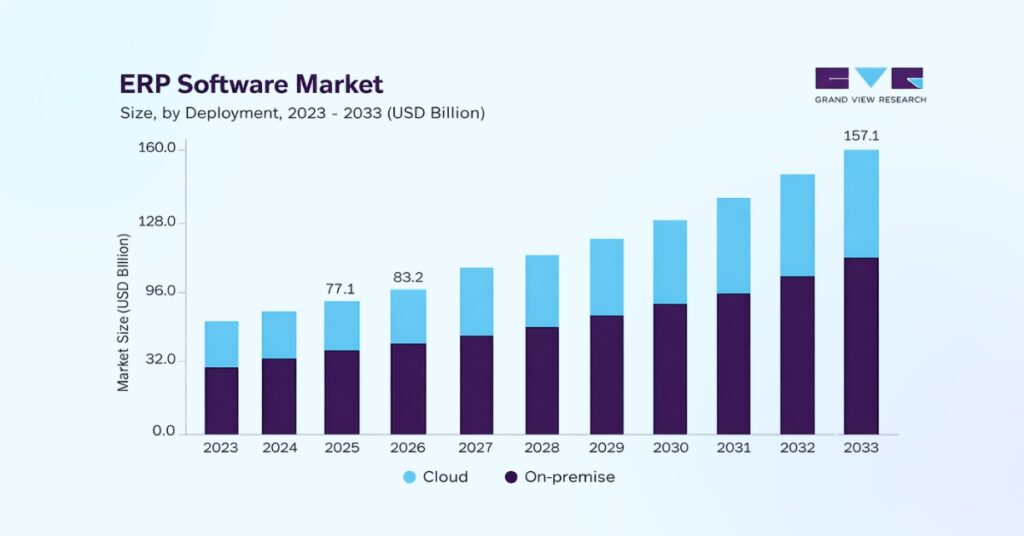
Source: Grandviewresearch
Why Do Operational Inefficiencies Become Normal Without ERP?
When businesses operate without ERP, disconnected tools create delays, duplicate work, and communication gaps across departments.
When departments use separate tools for finance, sales, HR, and inventory, teams spend more time coordinating than executing. Emails replace workflows, phone calls replace dashboards, and updates are frequently delayed.
- Duplicate work increases
- Approvals slow down
- Communication gaps widen
Rather than concentrating on performance and growth, employees spend time on processes that could have been optimized.
How Do Manual Workflows Increase Business Risk?
Manual workflows increase the risk of errors, delays, and dependency on human coordination.
As companies expand, these become more and more dangerous. What was once manageable becomes stressful for departments.
Small issues like manual data entry errors can skew reports, delay procurement, or mislead leadership decisions. A missed update or outdated document can create ripple effects across multiple teams.
Why Do Financial Reporting Errors Multiply Without ERP?
Without ERP, financial data remains fragmented, making reconciliation slow and increasing the chances of errors.
The finance department often collects data from multiple sources such as sales platforms, payroll systems, and banking systems. Without centralization:
- Data reconciliation becomes time-consuming
- Financial closing cycles are delayed
- Forecast accuracy decreases
Leadership ends up making decisions based on incomplete or outdated information.
How Does Poor Inventory Management Disrupt Growth?
Lack of centralized inventory tracking leads to stock mismatches, overstocking, and stockouts.
In product-based businesses, inventory management challenges are an important factor that affects profitability. If the inventory is not managed properly, there will be discrepancies in the inventory records and the sales or purchase records.
This creates a problem of having excess inventory of products that are not in high demand, while the products in high demand are out of stock. This ties up capital in inventory and also causes delays in delivery to customers.
Without accurate tracking and alignment between departments, growth becomes harder to sustain.
Why Are Supply Chain Disruptions Harder Without ERP?
Without ERP, businesses lack visibility and cannot proactively respond to supply chain disruptions.
The modern market is unpredictable, with delays, shortages, and price fluctuations. Without system-wide coordination:
- Procurement and sales forecasts are misaligned
- No early warning signals for shortages
- Teams react under pressure instead of planning ahead
How Do Compliance Risks Increase Without ERP Systems?
Manual processes increase the risk of compliance errors, incomplete records, and audit challenges.
Regulatory requirements are constantly evolving. Without structured systems:
- Audit trails remain incomplete
- Documentation becomes inconsistent
- Reporting delays increase
This can lead to penalties and reputational damage.
How Does Lack of ERP Affect Customer Experience Issues?
Disconnected systems lead to delays, billing errors, and inconsistent communication with customers.
Customers expect speed and reliability. Without internal coordination:
- Orders may be confirmed without inventory validation
- Payments processed without logistics visibility
- Delivery timelines become unreliable
Running Without ERP Software?
Disconnected systems can hold your growth back.
Explore Now →
Why Does Growth Become Difficult Without ERP?
Without ERP, scaling operations increases complexity, inefficiency, and operational costs.
As transaction volumes increase:
- Businesses hire more staff to manage data
- Processes become harder to standardize
- Expansion into new markets becomes challenging
How Does Lack of Real Time Visibility Slow Decision-Making?
In a competitive environment, speed is important. Leaders require accurate insights to act quickly on market changes.
Without real time visibility, decision-making is based on late reports and piecemeal information. By the time information is gathered, the opportunity may have already passed.
An integrated platform offers a single source of truth that allows for confident and proactive strategy.
What Are the Benefits of ERP Software and Business Process Automation?
Fragmented tools may seem economical initially, but hidden inefficiencies grow over time.
Key Benefits of ERP with Automation:
- Centralized data management
- Reduced manual errors and repetitive work
- Real-time reporting and analytics
- Improved compliance and transparency
- Reduce scalability challenges for better growth.
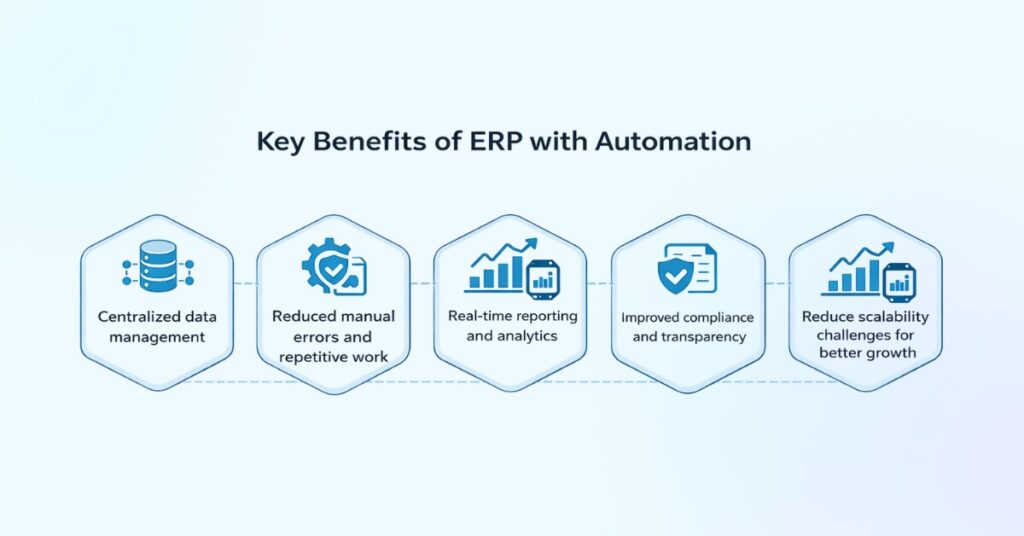
Manual Process vs ERP-Driven Process
| Process Area | Without ERP | With ERP Automation |
| Data Management | Scattered across systems | Centralized and real-time |
| Workflows | Manual and slow | Automated and efficient |
| Reporting | Delayed and inaccurate | Instant and reliable |
| Inventory | Misaligned and inconsistent | Accurate and demand-driven |
| Decision-Making | Reactive | Proactive |
Final Thoughts
Opportunity comes with growth, but so does complexity. Businesses that continue to operate without ERP often experience increasing inefficiencies over time.
In summary, disconnected systems may seem manageable initially, but when a business runs without ERP software, they eventually slow decision-making, increase risks, and limit visibility.
ERP is not just a technological upgrade, it is a strategic foundation for growth. By integrating data, automating workflows, and providing real-time insights, businesses gain clarity, control, and confidence.